Long before anyone sourced products online, China’s trade ran through its wholesale markets: enormous buildings where hundreds or thousands of vendors sell one kind of product, floor after floor. Many businesses still start there, and they remain the fastest way for global buyers to see what a category actually offers, compare many suppliers in a single afternoon and hold the goods in your hands before you commit. For anyone who needs to source products in volume, they are still the shortest route from idea to order.
This guide covers the main wholesale markets in China, what each one specializes in, how international buyers work in them, and when a market beats an online platform. Our own office sits in Jinhua in Zhejiang province, next to the Yiwu market, so much of this comes from working in these buildings rather than reading about them.
What Are China’s Wholesale Markets?
A Chinese wholesale market is a permanent trading complex, not a one-off fair. Each booth is run by a factory, a factory’s sales office or a trading company, and almost every market specializes: one for toys, one for fabrics, one for electronic components. Within that specialization you will find hundreds of competing vendors in one location.
That concentration is the whole point. Comparing suppliers that would take weeks of messages online takes an hour on foot, and prices are visible rather than negotiated from zero.
The Main Wholesale Markets in China
| Market | City | Specializes in |
|---|---|---|
| Yiwu International Trade City | Yiwu, Zhejiang | Small commodities, almost every category |
| Huaqiangbei | Shenzhen | Electronics and electronic components |
| Shahe, Baima, Shisanhang | Guangzhou | Clothing and fashion |
| Zhongda Textile Market | Guangzhou | Fabrics and trims |
| China Textile City | Keqiao, Shaoxing | Textiles, including technical textiles |
| Shiling Leather Market | Guangzhou | Bags, luggage, leather accessories |
| Chenghai | Shantou | Toys |
| Lecong Furniture Market | Foshan | Furniture and home furnishing |
| Linyi Commodity City | Linyi, Shandong | Household goods, hardware, stationery |
Yiwu: Small Commodities and Almost Everything Else
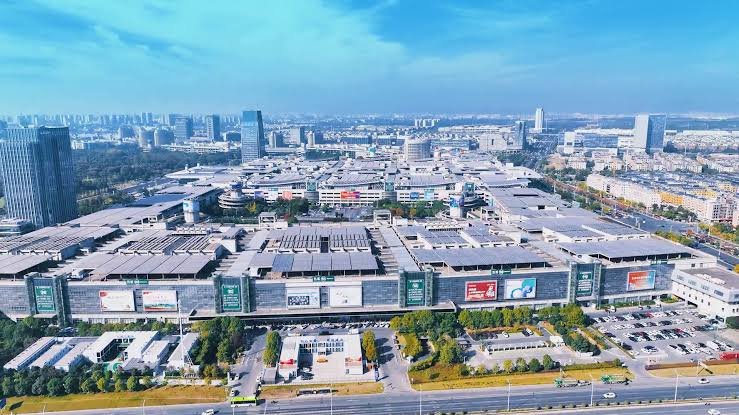
The Yiwu International Trade City is widely described as the world’s largest wholesale market for small commodities. It runs across five districts and is commonly reported to hold more than 75,000 booths, serving buyers from over 200 countries and regions. Each district is grouped by product family: toys and jewelry in one, hardware and electrical goods in another, bags, stationery, kitchenware, cosmetics, decorations and sporting goods spread through the rest.
What makes Yiwu unusual is the combination of range and low MOQ. Many vendors accept small quantities and mix orders, which is why it suits small businesses, distributors and anyone testing a new product line. Prices are wholesale prices, and most vendors have real export experience.
Huaqiangbei: Electronics
Huaqiangbei in Shenzhen is widely called the world’s largest electronics market, spread across more than ten buildings, and it is the reference point for sourcing electronics. Whole floors are given to electronic components, others to finished consumer electronics, accessories, repair parts and tools. It is where the latest innovations appear first, often weeks after a product launches elsewhere. Electronics importers get enormous choice here, along with the sharpest need for verification: quality between neighboring booths can vary widely.
Guangzhou: Fashion, Fabrics and Leather
Guangzhou is reported to host more than 500 specialized wholesale markets, many of them within a few kilometers of each other. Shahe and Shisanhang handle fast fashion at low prices, Baima leans towards better-finished clothing, and there are dedicated buildings for children’s clothing, footwear and underwear. The Zhongda textile market supplies fabrics and trims to the whole district, which is why many buyers develop custom products here: the fabric market and the clothing factories sit side by side. For bags and leather accessories, the Shiling leather market is the main destination.
Keqiao, Chenghai, Foshan and Linyi
China Textile City in Keqiao, in Shaoxing, is described as Asia’s largest textile trading center, with thousands of trading companies supplying raw fabrics and garment materials to clothing manufacturers, home textile businesses and buyers of technical textiles. Chenghai in Shantou is the toy cluster, home to tens of thousands of toy manufacturers and related businesses. Lecong in Foshan is an enormous furniture market where showrooms run for kilometers, covering home and office furniture and interior design elements. Linyi in Shandong is a general merchandise center that is far less known internationally than its size deserves.
The Canton Fair
The Canton Fair in Guangzhou is not a permanent market but a trade fair, held twice a year in three phases by product category. It attracts tens of thousands of buyers from around the world and is the best place to meet export-oriented manufacturers in a short time, a good complement to the markets: fairs for manufacturers, markets for immediate stock.
Why International Buyers Still Use Physical Markets
The key advantages are practical ones.
- Direct access to many suppliers. You can compare dozens of versions of the same product in a morning, with prices, materials and quality in front of you.
- Immediate product samples. You buy them on the spot rather than waiting for couriers.
- Honest quality comparison. Photographs flatter; a shelf of competing items does not.
- Lower minimums. Market vendors are used to mixed and smaller orders, which suits new importers.
- Speed. Stock is often available immediately rather than after a production run.
The trade-off is that you are seeing the goods, not the factory. A booth may be a manufacturer’s showroom or a reseller’s shopfront, and only supplier verification tells you which.
Choosing the Right Wholesale Market Location
Your wholesale market location should follow your product, not your flight. The China wholesale system is built around industrial clusters, and the manufacturing industry behind each one is what gives its markets their character. Buying inside the right cluster gives you better access to specialized factories.
- Guangdong in the south: Guangzhou for clothing, fabrics and leather, Shenzhen for electronics, Foshan for furniture, Shantou for toys. Close to Hong Kong and to the ports of Shenzhen and Guangzhou.
- Zhejiang and the east: Yiwu for small commodities in every category, Keqiao for textiles, Haining for leather and fur. Ningbo and Shanghai handle the freight.
- Shandong in the north: Linyi for household goods, hardware and stationery, serving large quantities at low prices.
Two practical points. First, group your trip around one cluster rather than crossing the country, because the time lost in transit is time not spent comparing suppliers. Second, check the port: shipping from the region where you bought is almost always cheaper than trucking goods across provinces first.
How to Buy From a Wholesale Market in China
A visit works best when the preparation is done before you arrive.
- Do the online research first. Know your target price, your quantity and your specification, and identify the right market and the right districts within it.
- Walk before you buy. Spend the first hours surveying, noting booth numbers and prices, then return to the shortlist.
- Collect product samples and cards. Photograph each booth number with the sample so the two do not get separated.
- Ask who makes it. Factory or trader, where it is produced, what the lead time is for large orders and what can be customized.
- Check the company, not just the booth. Ask for the business license and confirm the company name matches the bank account before you pay.
- Agree quality control in writing. For bulk orders, pay a deposit and tie the balance to an inspection against an approved sample.
- Calculate the landed cost. Market prices exclude freight, duties and taxes. Our guides to CBM, Incoterms and import duties cover those.
Buying several product categories usually means several suppliers and several small shipments. Consolidating them into one container is where most of the saving lies.
Freight is not a detail either. Air freight suits light, urgent goods and sea freight almost everything else, and the difference between them can change the landed cost more than the price you negotiated at the booth. Work out the total landed cost before you decide, not after.
What to Check Before You Pay
Markets reward buyers who verify and punish those in a hurry. These checks are essential whatever you are buying.
- Product quality against a standard, not a feeling. Decide the material, finish and tolerance you need, then judge every booth against that. Two items that look identical on a shelf often differ in thickness, stitching or component grade.
- Compliance for your market. Electrical goods, toys, cosmetics and food-contact items need certification in most countries. Ask what testing already exists before you choose on price.
- Intellectual property. Branded lookalikes are easy to find and will be seized at your own border. Buy unbranded goods or your own design.
- Who can actually produce. Many booths sell stock; fewer can run a custom order. Confirm production capacity and lead times, and for a larger first order consider an independent factory audit.
- How you pay. Use a secure payment method into the registered company’s account, and keep a pre-shipment inspection between the deposit and the balance.
- The real total. The cheapest unit price often carries the highest rejection rate, and a rejected shipment costs more than the saving.
Wholesale Markets or Online Platforms?
Platforms such as Alibaba, 1688, Made-in-China and Global Sources cover much of the same supply base, and for a simple repeat order they are faster. Markets earn their place when you need to judge quality by hand, work across different markets and categories at once, or develop custom products with a supplier who can show you materials.
In practice, most experienced importers use both: online research to narrow the field and set a price benchmark, then a market visit, or someone on the ground, to confirm what the photographs cannot.
How Alanovas Works in These Markets
Alanovas is a registered trading company in Jinhua, Zhejiang, next to the Yiwu International Trade City. We buy in these markets every week on behalf of clients in 17 countries, and we have handled more than 420 shipments.
We can source your products from the market that specializes in them, compare multiple suppliers on price and quality, verify companies through business licenses and national company records, negotiate on your behalf, inspect goods before shipment, consolidate items from several vendors into one shipment and prepare the export documents. Our service fee is quoted separately from the supplier’s price, and our team works in English, Arabic, French and Chinese. If you prefer to come yourself, we accompany clients to the Yiwu market and to the Canton Fair.
See our sourcing and supplier management service and our services and fees, or tell us what you are looking for.
Frequently Asked Questions
What is the biggest wholesale market in China?
The Yiwu International Trade City in Yiwu, Zhejiang province, is generally considered the world’s largest wholesale market for small commodities. It spreads across five districts and is commonly reported to hold more than 75,000 booths, grouped by product family: toys, jewelry, hardware, stationery, kitchenware, bags, cosmetics, decorations and much more.
Where is the best place to buy wholesale in China?
It depends on the product. Yiwu for small commodities and mixed orders, Huaqiangbei in Shenzhen for electronics and components, Guangzhou for clothing, fabrics and leather goods, Keqiao for textiles, Chenghai for toys, Foshan for furniture and Linyi for household goods and hardware. Choose the market that specializes in your category rather than the one nearest your flight.
Can foreigners buy directly from wholesale markets in China?
Yes. The markets are open to international buyers, and most vendors are used to dealing with them. The practical obstacles are language, payment in Chinese currency and arranging export, which is why many buyers work with a local agent who can transact, consolidate the goods from several vendors and handle the export documents.
What is the minimum order in a Chinese wholesale market?
Lower than most people expect. Many Yiwu vendors accept small quantities or a carton of each item, which makes mixed trial orders possible, while custom production normally starts in the thousands. Minimum order quantities are one of the main factors in sourcing from China, and combining items from several vendors into one shipment is the usual way to keep them workable.
Should I visit China or source products online?
Use both. Online platforms are faster for repeat orders and good for research and price benchmarking. A market visit, or someone on the ground for you, is better when you need to judge quality by hand, compare many suppliers quickly, or develop a custom product with a supplier who can show you materials.